
I can get the equivalent work of a squat exercise without having to put the bar across my shoulders. Yet I still have a closed chain activity engaged, I don’t have to think of an open chain. I don’t have to be out in the middle of the field with a chance to trip over a soccer ball or throw out my shoulder.
To strengthen my soccer kick or baseball throw in an open chain modality and put myself at risk because I can be in a fixed position and move my body part in such a way that I can avoid any injured area or any injury-prone part of the movement.
If I have a hitch in my shoulder or if I have an impingement in my shoulder or a problem with Thoracic Outlet I can infinitely adjust my position and still achieve the load without having to worry about a pinch point.
Because I can work around any pinch point by just shifting the position of the handle as I’m creating the contraction. And I don’t have to rely on gravity in any way shape or form to create the resistance for me.
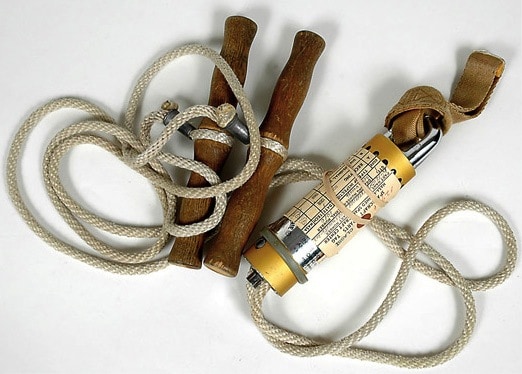
Using the Exer-Genie allows me to infinitely adjust the load to maximize the amount of resistance that I am capable of overcoming, plus any amount of force I need to overcome the resistance at any particular point in the range of motion. Something that almost no other exercise can do through any range of motion or angle.
The Exer-Genie does not rely on gravity. It can be used either as a gravity-based or an anti-gravity based exercise, which allows you to transition very easily between open and closed chain functional exercise.
It loads chain exercise constantly. It has the potential in the hands of the knowing practitioner to optimize the training effect. It can build a transition between open chain and closed chain exercises like almost no other training system.
